Calculating the Harvest

I’ve tried a variety of ways to keep up with my harvest calculations. My favorite way is to use a little Moleskine. It gets ported around the house, and can frequently be found resting on the kitchen counter or on the side-door steps. It’s also ideal for noting plantings and making diagrams.
I like that I’ll always have a diary of my garden’s history.
There’s still more to come, but here’s how much I’ve picked so far:
- Peas: .1 lb.
- Arugula: .2 lb.
- Cherry Tomatoes: 27.95 lbs.
- Cucumber: 4.56 lbs.
- Purple beans: 1.5 lbs.
- Green beans: .16 lb.
- Swiss Chard: .69 lb.
Grand total: 35.06 lbs.
And no, that’s not a typo: I did pick more than 27 pounds of CHERRY tomatoes.
How do you keep track of what you pick and how you plan?
Good Morning, Glory
“A morning-glory at my window satisfies me more than
the metaphysics of books.”
-Walt Whitman

What to do With Green Tomatoes
I pulled the oldes tomato vines out of the garden to make room for some late season plantings. But there were still lots of green tomatoes left. What to do?

Make tomato preserves!
I happened across a recipe while flipping through the Blue Book, and thought it sounded different and interesting. Added bonus: Green tomatoes were OK.
All that’s needed is the tomatoes, sugar, lemons, water, whole fresh ginger root, and pickling spices. It took me a day or two to find the pickling spices. Fortunately, I have a Penzey’s nearby.

While the recipe is incredibly simple, I managed to forget to skin the tomatoes. Since I’m still working with a bounty of cherry tomatoes, this meant trying to wiggle the skins off during the cooking process. I’m sure a few slipped by.

Yummy!
The concoction is thick, syrupy, and smells like a cozy mulled drink you’d like to be sipping on a fall evening. Maybe these preserve will work well for fall baked treats?
What do you do with your green tomatoes or other unripened garden items?
Welcome to Alisa’s Garden
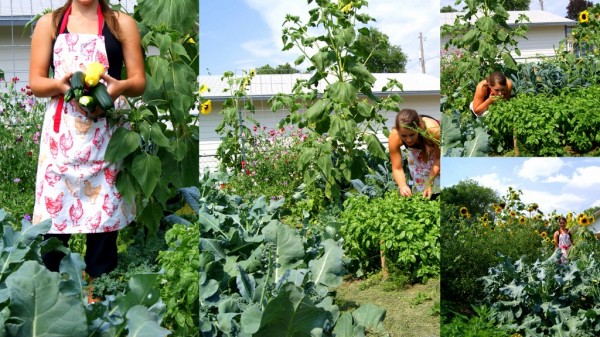
I love meeting so many people who have joined the local gardening and food movement.
Allow me to introduce you to Alisa, who has a fabulous blog going on over at Alisa’s Garden. From yummy recipes to lovely photography, there’s plenty to salivate over.
Make sure you try her garden rolls with ginger plum dipping sauce. I made them for today’s lunch and they’re amazing!

More Tomato Happenings

Despite the setting sun, my helper and I had to pick the available fruit.
The tomato plants keep on giving. I picked what I suspect is approaching 10 pounds these past few days. (My notes are at home and not with me.)
Some are red, some a green, but they all mean there’s more canning on the horizon.
Stay tuned!
First-Time Canning
There were eight pounds of cherry tomatoes hanging around my counter, meaning it was time to start preserving the bounty.

Last year I froze the tomatoes, but this year I wanted to try canning.
Here’s What I Learned
- Canning is basic, easy, and versatile.
- Canning is a precise science. Deviating from a tested recipe and procedure can lead to an unsafe product. Botulism is not cool.
- If you can follow directions, you can can.
- Canning takes time. Be prepared to dedicate your day.
- Buy a real canning rack!
- Canning makes me feel accomplished, and little like a down-home country girl.
I decided to can whole tomatoes. Since I’m overrun with cherry tomatoes, I had no choice but to do the tedious work of blanching and skinning each one. I imagine it’s more repetitive and time-consuming than with large tomatoes.
Since this was an experiment and a small batch, I wanted to keep my investment low. Rather than buy a full canning kit, I used my own stock pot, plus an improvised rack for the bottom of the pot (a metal steamer basket). The only items I bought were the wide-mouth jars and a jar lifter. This time of year, canning products are everywhere; I buy mine at Agway.
Things would probably have been faster and smoother if I had a rack to lower and lift the jars from the water bath, rather than balancing everything on a metal steamer in the bottom of the pot and picking the jars out one-by-one.
Finally, at 1 a.m. I pulled out six lovely pints, each with well-sealed lids. Yay!

Don’t Forget the Beans
I have two rows of pole beans that I started planting mid-June. Finally, there’s something to show for it.

These are my purple podded pole beans, and they’re awesome. I selected them from the seed catalog because I wanted something different, and the description enticed me with the suggestion of growing them in a tee-pee form for my child to play in. That part didn’t happen. (Next year, I promise!)
What I didn’t expect was how huge the beans would be. That’s a big bean!
Bean production is off to a slow start, but soon I hope to be reporting about lots of beans. I want to see them covering my kitchen counter.
O Little Honey Bee!
This doesn’t have anything to do with the garden; it didn’t even happen in the garden. But a visit from this little honey bee while I was reading made me happy.

Make Your Own Ollas
I first read about ollas (pronounced oh-yah) over at Little Homestead in the City. Basically it’s an ancient irrigation method that uses unglazed, porous clay pots buried within the root zones of plants. Water poured into the exposed necks of the pots (or pitchers) naturally seeps into the soil, providing a continuous supply of water to the plants.
I’m intrigued by any method of watering that reduces consumption and is more natural. Ollas seem like the perfect answer, but premade ones can be expensive if you’re using them to irrigate everything.
Then I found a gardener named Matt who posted an excellent how-to for making your own ollas using nothing more than inexpensive terra cotta pots.
I followed Matt’s tutorial, and here’s how it went:
STEP ONE: ACQUIRE INEXPENSIVE POTS

This time of year they’re easy to find, and I bought these 15-inch pots for $1 each at Job Lot.
STEP TWO: SEAL ONE END OF THE OLLA

You don’t want water flowing out of the bottom of your finished product. Before gluing and stacking the pots, I sealed one drain hole using a 2×2 inch tile left over from a remodeling project.
I should mention here that my adhesive of choice was Gorilla Glue. I debated buying silicone, but wanted to keep the experiment cheap, so I used what I already had. According to their Web site, Gorilla Glue is waterproof.
STEP THREE: GLUE THE EDGES OF THE POTS AND STICK THEM TOGETHER

It really couldn’t have been easier. The pots are stable in the center. With Gorilla Glue you have to put pressure on the adhesive while it cures. The best I could do was tape and rocks. It worked.
As you can see, the glue expands when it dries, creating a water-tight seal.

STEP FOUR: DIG HOLE, INSERT OLLA

I chose to place this one near my young pumpkins. If the plants weren’t established, I would have planted seeds closer to the olla. However, digging around these delicate young plants was precarious, so I kept my distance.
STEP FIVE: BURY OLLA

STEP SIX: VISIT YOUR RAIN BARREL AND GET A BUCKET OF WATER

These ollas will hold approximately 3/4 of a gallon, so fill ’em up!
You’ll need to keep something over the hole to prevent insects, rodents, and debris from getting inside. If you live in the Northeast, you probably have a handy rock collection.

STEP SEVEN: ADD A ROCK (FOR EXTRA BEAUTY)

That’s it! It took me 24-hours to make five ollas, with most of the time spent letting the glue cure overnight.
Here are a few notes and considerations:
- In climates with deep freezes, ollas probably won’t survive the winter. It’s best to remove them in the fall.
- I’m still experimenting with placement and numbers. I will monitor the moisture in the soil to see how far it penetrates.
- Just because the olla is empty doesn’t mean it needs to be refilled. Again, monitor the moisture of the soil.
Bad Luck Basil
These are my basil plants. It’s the second year I’ve tried growing basil, and I can’t get it right.

Here’s where I think I went wrong: I sowed the seeds directly into potting soil. The first year I put them in the ground (I can’t remember if they were seedlings or direct-sow), and they bolted.
Also, some kind of invisible pest has been consuming the leaves. In fact, nearly all the plants on the property have fallen victim to mysterious munchers.
I’m jealous of people who say “I have too much basil.” I love basil, and can’t wait to have the same bounty others seem to achieve with little effort.
I’d like to try keeping basil in containers. Anyone have suggestions for the ideal growing medium?


 The Suburban Farm